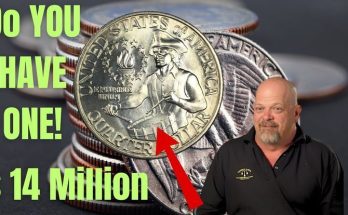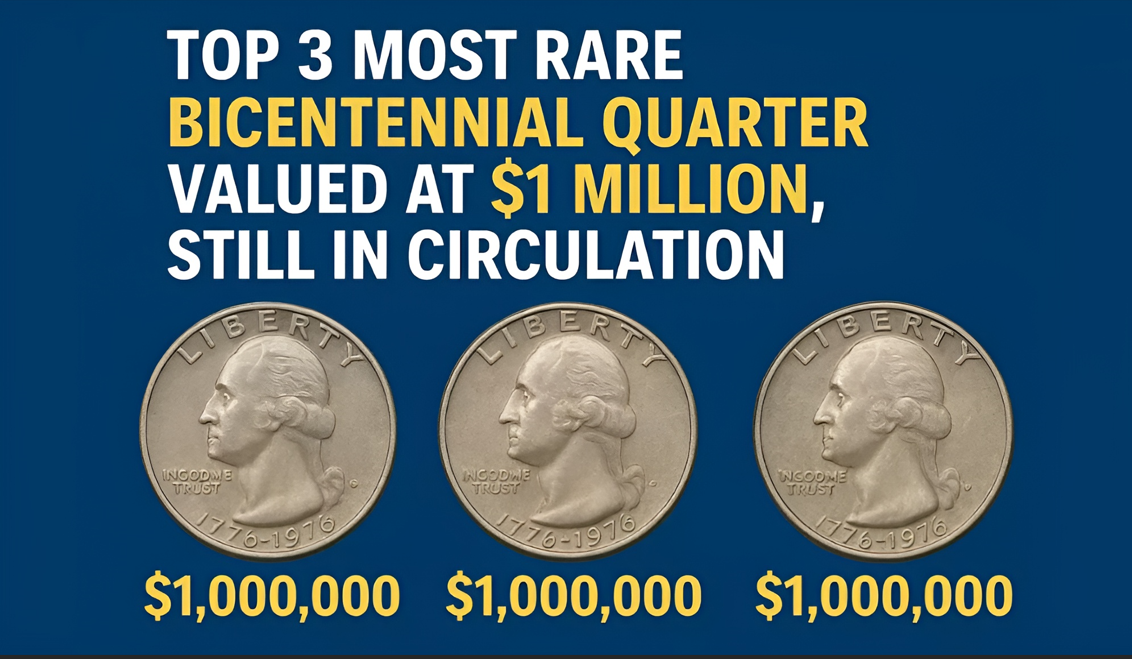
The 1976 Bicentennial Quarter is one of the most recognizable U.S. coins ever made, featuring the dual date “1776–1976” and a Colonial drummer on the reverse. Millions were produced, and most are worth only face value today. Yet persistent headlines claim that a handful are valued near $1 million and may still be circulating.
What separates fact from fiction? This article explains the reality behind those claims, identifies the three rare Bicentennial Quarter types most often associated with seven-figure valuations, and provides practical guidance for evaluating coins responsibly—without hype or exaggeration.
Understanding Bicentennial Quarters and Their True Rarity
The U.S. Mint struck Bicentennial Quarters in 1975 and 1976 to celebrate America’s 200th anniversary. Standard issues were produced in enormous quantities at Philadelphia and Denver, while special collector versions were struck in San Francisco, including 40% silver proofs.
Because of these volumes, ordinary circulated examples are common and inexpensive.Seven-figure values are not attached to standard coins. Claims of million-dollar Bicentennial Quarters hinge on extraordinary circumstances: unique minting errors, exceptional preservation, or speculative narratives.
With that context, the following three categories are the only ones ever discussed in connection with extremely high valuations.
1) The Alleged 1976 Bicentennial Quarter Struck on a Silver Planchet
This story centers on a quarter accidentally struck on a 40% silver planchet intended for collector issues, but bearing circulation characteristics. In theory, such a mistake would be exceptionally rare. For a coin like this to approach a $1 million valuation, it would need ironclad authentication, flawless condition, and clear provenance.
In practice, no publicly documented sale confirms a seven-figure result for a Bicentennial Quarter of this type. However, a verified off-metal strike in pristine condition could command a substantial premium. Collectors should be cautious: many coins claimed as “silver errors” are simply plated or altered after leaving the Mint.
2) A One-of-a-Kind Double Die with Dramatic, Verified Doubling
Double die errors occur during the die creation process, producing doubled lettering or devices. Minor doubling is common and modestly valuable. A dramatic, unmistakable double die—clearly visible without magnification and confirmed by experts—would be rare for Bicentennial Quarters.
To justify an extreme valuation, the doubling would need to be unique, bold, and paired with top-tier condition. While collectors actively seek such errors, there is no confirmed instance of a Bicentennial Quarter double die selling anywhere near $1 million. Assertions to the contrary remain unverified.
3) An Ultra-High-Grade Proof Error with Perfect Preservation
San Francisco struck Bicentennial Quarters as proofs, including 40% silver versions. Proofs are carefully made, but errors can occur. A proof coin with a major mint error—such as a wrong planchet or missing element—combined with perfect preservation could, in theory, attract enormous interest.
Even here, values depend on market demand and documentation. The numismatic record does not support a $1 million sale for a Bicentennial Quarter proof error. Extraordinary claims require extraordinary evidence, and the market has not produced it.
Why “Still in Circulation” Claims Persist
The idea that a million-dollar coin could be hiding in pocket change is compelling. It fuels searches and stories. In reality, coins capable of commanding extreme prices are almost always identified early and removed from circulation. While rare errors can be found by chance, the likelihood of a seven-figure Bicentennial Quarter casually circulating is extremely low.
How to Evaluate a Bicentennial Quarter Responsibly
If you believe you have something unusual, follow a disciplined process:
- Check the basics: Confirm the dual date, mint mark, and weight.
- Look for genuine errors: True mint errors show metal flow and consistency, not surface alterations.
- Assess condition: Value rises sharply with preservation; most circulated coins fall short.
- Seek professional authentication: Independent grading and attribution are essential.
- Avoid assumptions: Headlines are not appraisals.
This approach protects you from false expectations and ensures credibility if your coin proves noteworthy.
Market Reality Versus Online Valuations
Online valuations often conflate possibility with probability. While the Bicentennial Quarter is historically important and beloved, the numismatic market values documented rarity and condition, not rumors.
Coins approaching $1 million are typically unique, famous, and well-provenanced—attributes not associated with standard Bicentennial issues.
Summary
The Bicentennial Quarter is a fascinating piece of American history, but claims of $1 million examples still in circulation are not supported by confirmed market evidence. Only three highly speculative categories—off-metal strikes, dramatic double dies, and exceptional proof errors—are ever mentioned in such discussions.
Collectors should approach these stories with curiosity, not expectation, and rely on verification, condition, and documented sales. Knowledge, not hype, is the true path to value.