The Susan B Anthony dollar holds a unique place in American numismatic history. First minted in 1979, it was the nation’s attempt to introduce a small-sized dollar coin that could replace the bulky Eisenhower dollar and reduce reliance on paper currency. Featuring the likeness of women’s rights activist Susan B Anthony, it became the first circulating U.S. coin to honor a real woman rather than a symbolic figure. While its production was short-lived, the coin remains a fascinating collectible with stories of rarity, value, and historical significance.
The Birth of the Coin
In the late 1970s, the U.S. Treasury sought a practical dollar coin that would be easier to carry and cheaper to produce than paper notes. Congress approved the design, and in 1979 the Susan B Anthony dollar entered circulation. The coin was struck in copper-nickel clad composition, similar to quarters, and measured 26.5 millimeters in diameter. Its obverse featured Anthony’s portrait, while the reverse carried the Apollo 11 mission insignia, a design borrowed from the Eisenhower dollar. Despite its noble intent, the coin faced immediate challenges.
Public Reaction and Circulation Problems
The Susan B Anthony dollar was often mistaken for a quarter due to its size and color. Vending machines, cash registers, and even consumers struggled to adapt. As a result, the coin never gained widespread acceptance. By 1981, production for circulation ceased, though limited mintages appeared again in 1999 to meet demand for vending and transit systems. Its short run and unusual history make the 1979 issues especially interesting to collectors today.
Key Varieties of the 1979 Dollar
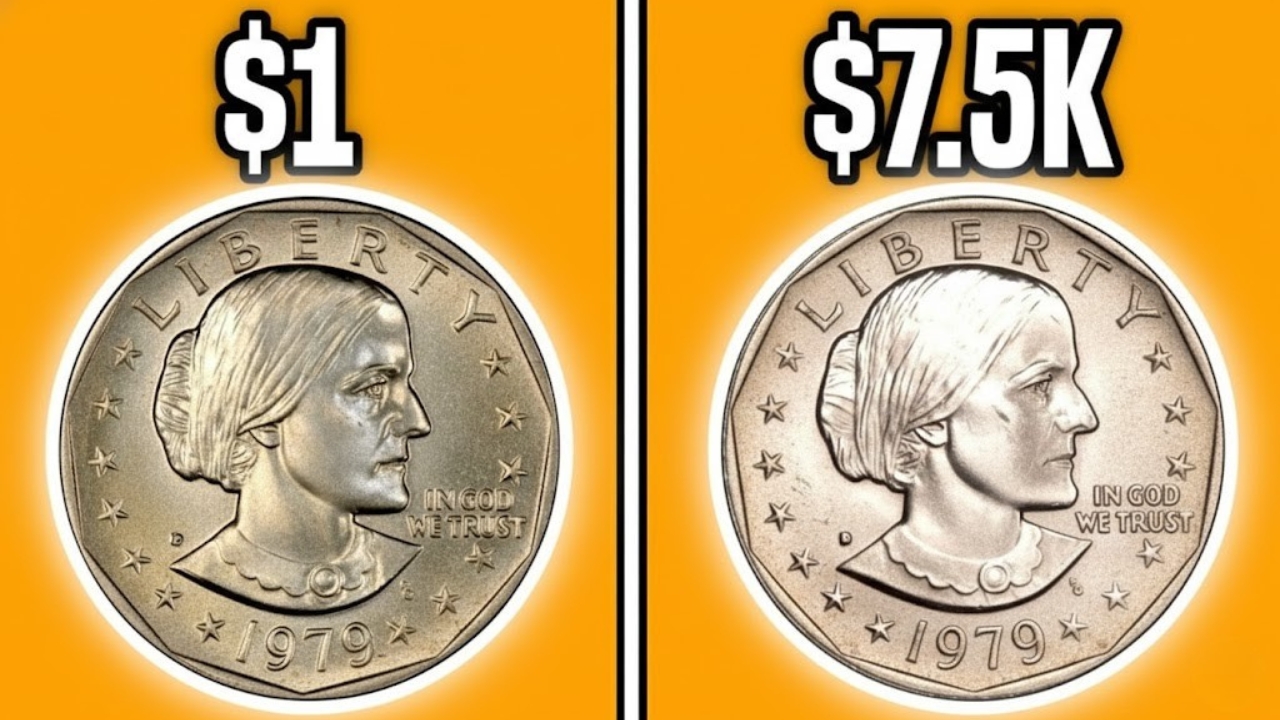
Collectors prize certain varieties of the 1979 Susan B Anthony dollar. The most notable are the “Wide Rim” and “Narrow Rim” versions. Early strikes featured a narrow rim, but later adjustments produced a wider rim that gave the date more spacing from the edge. The Wide Rim variety is scarcer and commands higher premiums. Additionally, proof coins struck at the San Francisco Mint display exceptional detail and mirror-like surfaces, appealing to numismatists who value artistry and precision.
Mint Marks and Their Significance
The 1979 Susan B Anthony dollar was produced at three mints: Philadelphia (no mint mark), Denver (D), and San Francisco (S). Each mint mark carries its own level of desirability. Philadelphia coins are the most common, while Denver issues are slightly scarcer. San Francisco produced both circulation strikes and proofs, with the latter being highly sought after. Proof coins often showcase frosted devices against polished fields, making them visually striking and collectible.
Value of the 1979 Susan B Anthony Dollar
Most 1979 Susan B Anthony dollars in circulated condition are worth only face value. However, uncirculated examples and special varieties can bring higher prices. A standard uncirculated coin may sell for a few dollars, while the Wide Rim variety can reach $25 or more depending on grade. Proof coins, especially those with deep cameo contrast, may command $50 or higher. Exceptional specimens graded by professional services can achieve even greater premiums, particularly if they exhibit flawless surfaces and sharp strikes.
Collecting Strategies
For collectors, the 1979 Susan B Anthony dollar offers multiple avenues of interest. Beginners may start with circulation strikes from each mint, building a simple three-coin set. More advanced collectors pursue proof issues, Wide Rim varieties, and high-grade certified examples. Some enthusiasts enjoy assembling complete date-and-mint sets spanning 1979 through 1981 and the 1999 revival. Because the series is short, it is relatively easy to complete, making it an attractive project for hobbyists.
Historical Importance
Beyond its monetary value, the Susan B Anthony dollar represents a milestone in American coinage. It honored a pioneering woman who fought tirelessly for suffrage and equality. The coin also reflected the government’s attempt to modernize currency, even if the experiment ultimately failed. Its story illustrates the challenges of changing public habits and the delicate balance between practicality and tradition in monetary design.
Market Trends and Future Outlook
The market for Susan B Anthony dollars remains steady. While most examples are common, demand persists among collectors who appreciate its historical significance. Rare varieties and high-grade proofs continue to attract attention at auctions. As time passes, pristine specimens may grow scarcer, potentially increasing their value. However, the coin is unlikely to achieve the legendary status of rarities like the 1804 dollar or 1913 Liberty nickel. Instead, it occupies a niche as a modern collectible with a compelling backstory.
Tips for Collectors
When collecting 1979 Susan B Anthony dollars, condition is key. Look for coins with minimal wear, strong luster, and sharp details. Wide Rim varieties should be authenticated to avoid confusion with common strikes. Proof coins should be stored carefully to preserve their mirrored surfaces. Consider professional grading for coins that appear flawless, as certification can enhance both value and buyer confidence. Finally, enjoy the process of learning about the coin’s history and place in American culture.
Conclusion
The 1979 Susan B Anthony dollar is more than just a piece of currency. It is a symbol of progress, experimentation, and the challenges of innovation. Though it failed in circulation, it succeeded in honoring a trailblazing figure and leaving a lasting impression on numismatics. For collectors, it offers affordable entry points, intriguing varieties, and a story worth preserving. Whether you hold one as a keepsake or pursue a complete set, the Susan B Anthony dollar remains a fascinating chapter in America’s coinage history.