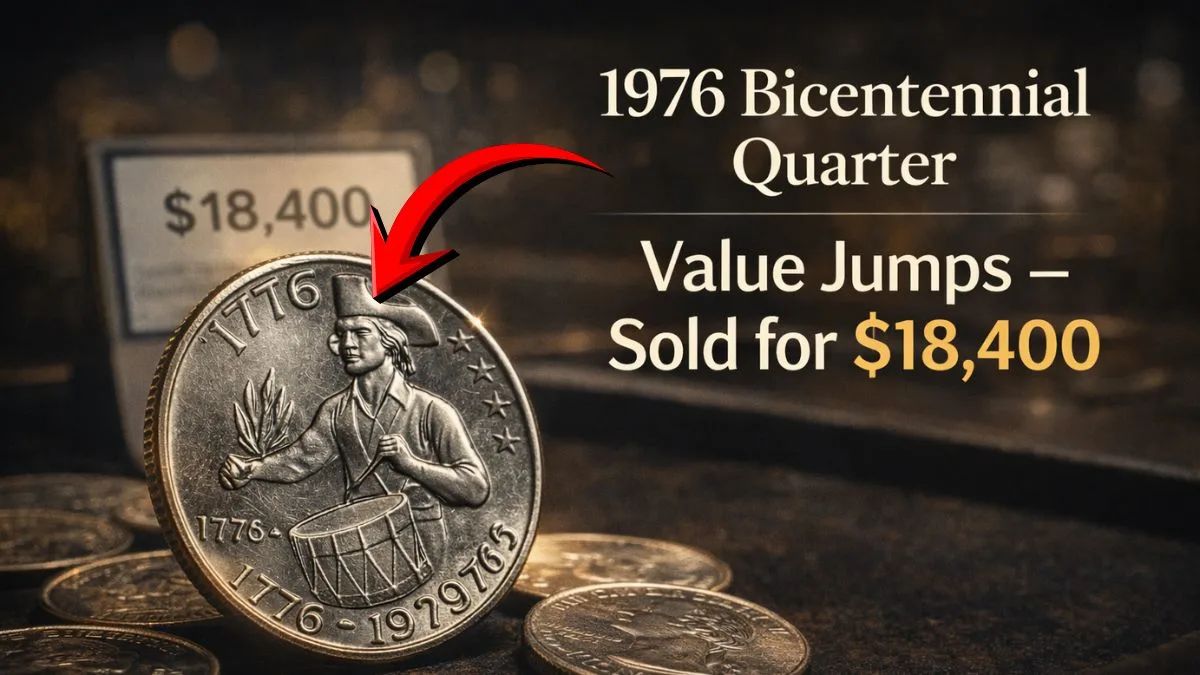
The 1976 Bicentennial Quarter, sometimes called the Centennial Quarter, has recently drawn global attention after an extraordinary example sold for $18,400 at auction.
Struck to honor the 200th anniversary of American independence, this coin has evolved from everyday currency into a highly sought-after collectible.
While most remain worth just 25 cents, a small number have achieved four- and even five-figure prices. Understanding why comes down to history, composition, condition, and rarity.
Background of the 1976 Bicentennial Quarter
To commemorate two centuries of independence, the U.S. Mint issued special quarters in 1976 with a design unlike any previous circulating quarter.
The traditional eagle reverse was replaced with a colonial drummer, created by artist Jack L. Ahr, symbolizing the spirit of the American Revolution.
The front of the coin continued to feature George Washington, but the date was changed to the dual inscription “1776–1976”, highlighting the bicentennial celebration.
Although hundreds of millions were produced for circulation, the Mint also released proof and silver versions specifically for collectors—these are where the real value lies today.
Why One Bicentennial Quarter Reached $18,400
The quarter that achieved a price of $18,400 was far from ordinary pocket change. Its value came from a rare combination of factors: perfect preservation, silver composition, and elite certification.
This standout coin was identified as a 1976-S Silver Proof Quarter, graded PR70 Deep Cameo—the highest possible proof grade. Coins with this designation display flawless surfaces and dramatic contrast between frosted details and mirrored fields.
With limited supply and strong collector demand, this pristine example commanded a remarkable premium at auction.
Different Types of 1976 Bicentennial Quarters
Not all 1976 quarters are created equal. The Mint produced several varieties, each with distinct characteristics and value potential:
| Type | Mint Mark | Composition | Mint Location | Mintage |
|---|---|---|---|---|
| 1976 (No Mint Mark) | None | Copper-Nickel | Philadelphia | 809,784,016 |
| 1976-D | D | Copper-Nickel | Denver | 860,118,839 |
| 1976-S Clad Proof | S | Copper-Nickel | San Francisco | 7,059,099 |
| 1976-S Silver Proof | S | 40% Silver | San Francisco | 4,000,000 |
| 1976-S Silver Uncirculated | S | 40% Silver | San Francisco | 11,000,000 |
Most circulated examples hold only face value. However, silver proofs and high-grade uncirculated coins can range from $10 to $500, with exceptional specimens climbing much higher.
How to Spot a Valuable 1976 Quarter
Collectors evaluate several critical traits when assessing a Bicentennial Quarter:
- Mint Mark: Found below Washington’s hair ribbon. “S” indicates San Francisco, “D” marks Denver, and no mark means Philadelphia.
- Metal Content: Silver versions weigh about 5.75 grams, slightly heavier than copper-nickel coins at 5.67 grams.
- Condition: Coins graded MS67+ or PR69–PR70 are significantly more valuable.
- Mint Errors: Unusual striking mistakes can greatly boost worth.
Rare Errors That Drive Prices Higher
Minting errors are among the biggest value boosters for Bicentennial Quarters. Highly desirable examples include:
- Double Die Obverse – Visible doubling on the date or inscriptions like IN GOD WE TRUST.
- Off-Center Strikes – Designs struck away from the center, leaving blank areas.
- Clipped Planchets – Missing sections along the coin’s edge.
- Wrong Planchet Errors – Quarters struck on metal intended for other coins.
Verified error coins authenticated by professional grading services often sell for substantial premiums.
How to Evaluate Your 1976 Quarter
If you think you may have a valuable example, take these steps:
- Check the Mint Mark to identify the issuing mint.
- Weigh the Coin to confirm whether it contains silver.
- Assess the Condition—never clean the coin, as this lowers value.
- Consider Professional Grading, which adds credibility and market appeal.
Growing Market Demand and Collector Interest
Interest in 1976 Bicentennial Quarters has surged as collectors reconnect with coins tied to major historical milestones. The combination of distinctive design, silver content, and limited high-grade survivors continues to fuel demand.
Auction trends show that while most remain common, top-graded and error varieties have achieved impressive prices, occasionally exceeding $10,000.
Recent 2024–2025 auction results indicate growing demand for 1976-S Bicentennial Quarter silver proofs and certified error coins, with PR69–PR70 examples becoming harder to source.
Numismatic analysts note increased collector interest ahead of the U.S. Bicentennial legacy market, keeping top-grade prices strong despite stable bullion values.
Practical Tips for Collectors and Sellers
- Handle Carefully using gloves to prevent fingerprints.
- Avoid Cleaning, which permanently damages value.
- Store Securely in protective holders or capsules.
- Research Market Prices and seek expert opinions before selling.
These practices help preserve condition and maximize potential returns.
The 1976 Bicentennial Quarter proves that ordinary coins can sometimes become extraordinary collectibles.
While the majority are worth just face value, silver proofs, pristine grades, and rare minting errors can transform a simple quarter into a high-value numismatic treasure—like the example that recently sold for $18,400.
For collectors and casual enthusiasts alike, taking a closer look at your change could reveal a surprising piece of American history.
FAQs
Are all 1976 Bicentennial Quarters valuable?
No. Most circulated versions are worth only 25 cents unless they contain silver, are high-grade, or have rare errors.
How can I tell if my quarter is silver?
Check for an “S” mint mark and weigh the coin—silver versions are slightly heavier.
Should I get my Bicentennial Quarter graded?
Yes, if it appears uncirculated, proof-like, or has an error. Professional grading can greatly increase value.