$24,000 Paper Money Errors?
 Hidden Treasures in Your Wallet?
What if an ordinary $1 bill could be worth thousands—or even tens of thousands—of dollars?
Believe it or not, rare paper money errors are hiding in plain sight. In this guide, we’ll walk step by step through six incredible U.S. paper money errors that sold for $7,000 to $24,000+ at major auction houses like Heritage Auctions and Stack’s Bowers.
 All bills discussed here are 100% genuine
All sales were finalized and paid in full
Prices reflect real collector demand
Let’s begin 
 #1 – 1942 $1 Hawaii Note (Inverted Overprint Error)
 Sold for $7,050
At first glance, this looks like a normal $1 Silver Certificate—until you notice two strange details:
 Brown seal and serial numbers
 The word “HAWAII” printed on the bill
 Why These Notes Exist
After the attack on Pearl Harbor (December 7, 1941), the U.S. government feared a possible Japanese invasion of Hawaii. In 1942, special Hawaii overprint notes were issued for circulation only in Hawaii.
 If Hawaii had been captured, the U.S. could declare all Hawaiian currency worthless, preventing economic sabotage.
 The Error
On this example, the HAWAII overprint on the back is upside down — an extremely rare and dramatic printing mistake.
 Most Hawaii $1 notes sell for a few hundred dollars, but this inverted overprint pushed the value to $7,050.
 #2 – Modern $1 Bill LEP (Lepe) Press Error
Sold for $7,200
This error was produced on a LEP (Large Examining and Printing) Press, a modern single-note printing system introduced by the Bureau of Engraving and Printing in the 2010s.
 Why LEP Press Errors Matter
- Single-note printing (not large sheets)
- Higher automation and quality control
- Errors are much rarer than older sheet-printed notes
The Error
- Mismatched serial number
- A green block appears where the “1” should be
This type of mistake should never pass inspection—yet it did, resulting in a $7,200 sale.
 #3 – 1935-E $1 Silver Certificate (Multiple Overprints)
Sold for $9,600
This historic note dates back to a time when you could take a $1 bill to the bank and exchange it for silver.
The Errors
- Multiple overprint strikes
- A long red rejection crayon mark
 What Went Wrong?
A quality control inspector correctly identified the error and marked it for rejection—but the sheet was never destroyed and somehow entered circulation.
That mistake turned into a $9,600 payday for a collector.
 #4 – 1995 $1 Bill (Mismatched Serial Numbers)
Sold for $16,800
This bill was graded PMG Very Fine 25, yet condition wasn’t the main value driver.
The Error
- Completely mismatched serial numbers
- Serial pairs do not correspond at all
This type of error is rare, visually obvious, and highly desirable—resulting in a $16,800 auction result.
 #5 – 1988 $1 Bill (Multiple Impressions Error)
Sold for $21,600
This error becomes obvious only when you flip the bill over.
What Happened?
- Back of the bill printed normally
- Front printed normally
- Bill accidentally went through the press again
The Result
- The back design printed on the front
- Multiple overlapping impressions
Errors like this are dramatic, unmistakable, and extremely valuable—hence the $21,600 price tag.
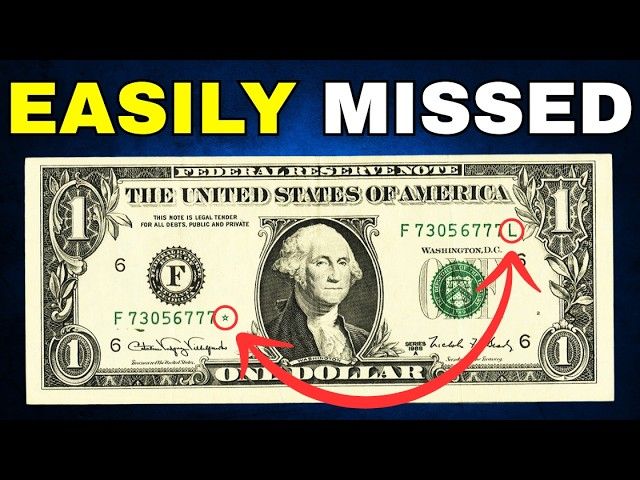
 #6 – Web Note + Mismatched Suffix Error
Sold for $24,000
This is the most valuable bill on the list—and it combines two major rarities in one note.
 What Is a Web Note?
A web note was printed using a special web-fed press. You can identify one by checking the back plate position:
- Normally found near the bottom right of the “ONE”
- On web notes, it appears to the right of “IN GOD WE TRUST”
The Errors
- Web note printing (rare by itself)
- Mismatched suffix letters
- One serial ends with a
 star
star - The other ends with an L
- One serial ends with a
This double rarity pushed the value to $24,000.
Final Thoughts: Check Your Bills Carefully
Paper money errors are:
- Often overlooked
- Still circulating
- Worth thousands when authentic
 Always check:
- Serial numbers
- Seals
- Overprints
- Plate positions
You never know what kind of hidden treasure might be sitting in your wallet.