I have a vivid memory from my childhood, one that I can recall with surprising clarity despite the many years that have passed.
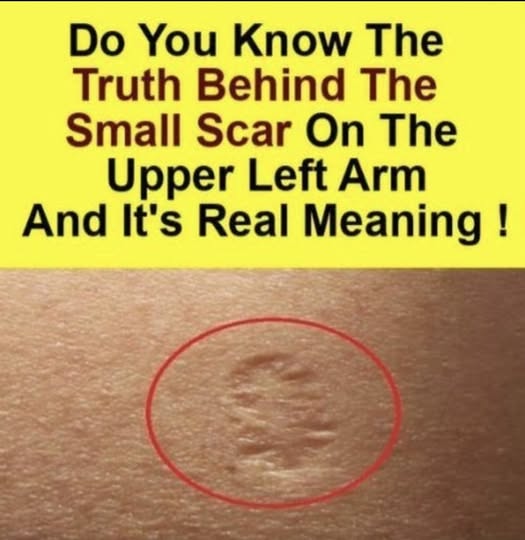
I remember noticing a distinct scar on my mother’s arm — high up, near her shoulder — that drew my attention for reasons I cannot explain.
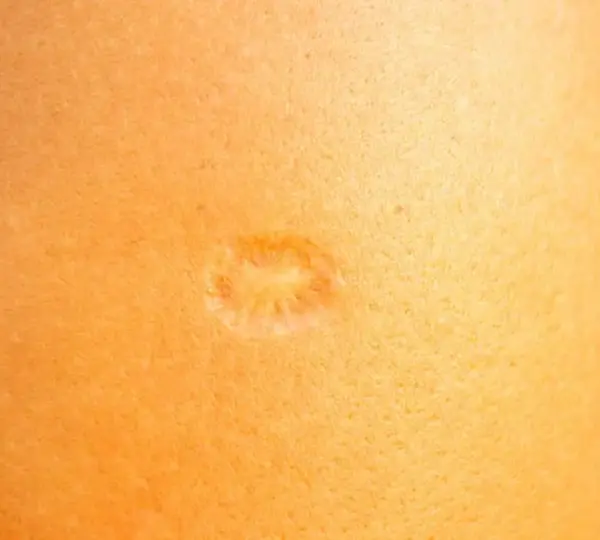
It wasn’t just a small mark; it had a peculiar formation. Around a slightly larger central indentation was a ring of tiny, evenly spaced indentations, almost as if someone had deliberately etched a pattern into her skin.
At the time, I had no understanding of what it meant or why it was there, but something about it captivated me. I can’t explain why my attention was drawn to it — perhaps it was the irregularity of its texture or the way it contrasted against her otherwise smooth skin.
My child’s curiosity was piqued, yet, like many childhood fascinations, it faded into the background of everyday life. Over the years, I didn’t consciously think about the scar, and my memory of my earlier fascination became a distant, almost forgotten detail.

Years later, however, a small moment brought the memory rushing back. I was helping an elderly woman off a train one summer. As I guided her carefully down the steps, my gaze happened to fall on her arm.
There it was — the very same kind of scar, in the exact same location as my mother’s. My curiosity reignited instantly, a flash of recognition that transported me back to that long-ago moment in my childhood.
The train was moving, and time was short. I couldn’t pause to ask the woman about the scar’s origins. Instead, I called my mother later that day, eager to revisit a piece of her past.
It turns out that I had been told about this scar before. My mother explained, patiently and thoroughly, that it was the mark of the smallpox vaccine — a piece of medical history my younger mind had apparently deemed unimportant enough to forget.
The scar was a relic of a disease that once terrified humanity: smallpox, a viral infection that caused fever, severe skin rashes, and, in many cases, death.
According to the Centers for Disease Control and Prevention (CDC), smallpox was responsible for killing roughly 30% of those infected during outbreaks in the 20th century, leaving many survivors with permanent scarring and disfigurement.
The story of smallpox is a story of both tragedy and triumph. The disease spread rapidly and lethally, leaving entire communities devastated.
Hospitals and public health officials struggled to contain outbreaks, and many regions implemented quarantine measures to try to curb its spread. For centuries, smallpox had no true cure, and its mortality rate made it one of the most feared diseases in history.
Families lived in constant fear that the next outbreak might reach their doorsteps, and survivors often bore visible scars that told the story of their brush with the disease.
The Role of the Smallpox Vaccine
The invention and widespread distribution of the smallpox vaccine changed the course of human history. First developed in the late 18th century by Edward Jenner, the vaccine used material from cowpox lesions to confer immunity against smallpox.
Over time, vaccination campaigns became more systematic, and by the mid-20th century, routine vaccination was common in many countries, including the United States.
These programs ultimately led to the eradication of smallpox in the U.S. by 1952, with routine vaccination ceasing in 1972. Globally, the World Health Organization declared smallpox eradicated in 1980, marking the first time humanity successfully eliminated a major infectious disease.
Before vaccination ended, however, every child born in the United States received the smallpox vaccine. This vaccination left behind a distinct, often circular scar, usually on the upper arm, near the shoulder — the exact location where I had noticed my mother’s mark.
The scar served as a kind of early vaccine “passport,” visible proof of immunity. Anyone who had the scar could be assumed to have been protected against one of the deadliest diseases known to humanity.
Why the Smallpox Vaccine Left a Scar
The distinctive appearance of the smallpox vaccination scar was not accidental; it was a natural outcome of the vaccine’s administration and the body’s response to it.

Unlike most modern vaccines, which are delivered via a single injection into the muscle or subcutaneous tissue, the smallpox vaccine used a bifurcated (two-pronged) needle.
This design allowed the administrator to deposit the vaccine into the skin’s dermis, the layer just below the outer epidermis.
The technique involved multiple punctures in a small area, effectively scratching the vaccine into the skin. The virus in the vaccine then replicated locally, triggering an immune response.
This response manifested as a small red bump that would develop into a vesicle, or blister, filled with fluid. Over several days, the vesicle would become larger, eventually forming a scab.
When the scab fell off, it left a permanent mark: the iconic smallpox vaccination scar. The pattern of smaller surrounding indents around a larger central one reflected the characteristic technique of puncturing the skin multiple times, a method that maximized the vaccine’s effectiveness.
From a medical standpoint, the scar was a visual sign of successful vaccination. Healthcare providers could easily identify those who had received the vaccine and were presumably immune.
In the era before digital medical records, a small scar on the arm functioned as a lifelong certificate of protection against a disease that had once claimed millions of lives.
Personal Reflection and the Legacy of Vaccination
For me, seeing the same scar on a stranger years later sparked a profound realization about memory, history, and the quiet ways our bodies carry the past.
The scar is more than just a mark of a medical procedure; it is a living artifact of human ingenuity, public health progress, and the struggle against one of history’s deadliest viruses.

Each scar tells a story of survival, of collective effort, and of the scientific advancements that allowed humanity to triumph over disease.
It also reminded me of the fragility and impermanence of memory. My childhood fascination with my mother’s scar had faded over time, buried beneath decades of everyday experiences.
Yet, when confronted with the same pattern elsewhere, that memory surged back with unexpected clarity. It highlighted how certain details — seemingly trivial in the moment — can carry immense historical and personal significance when viewed through the lens of reflection.
In a broader sense, the scar symbolizes the power of vaccines to protect entire generations. Smallpox may have been eradicated, but the lessons remain.
Vaccination campaigns continue to save millions of lives every year, preventing outbreaks of diseases that once wreaked havoc on communities worldwide. The smallpox scar, once common, now stands as a reminder of what can be achieved when science, policy, and collective action intersect.
The Modern Context: Vaccination and Public Health
While smallpox vaccination has long ceased in the U.S., the principles behind it continue to inform modern public health practices.
Vaccines for diseases like polio, measles, and COVID-19 have relied on similar immune system principles, though modern methods are typically less invasive and rarely leave permanent marks. Yet the smallpox scar serves as a tangible connection to a time when vaccination was both a personal and societal milestone.
It also reminds us of the human aspect of medicine — that behind every policy, procedure, or viral eradication effort, there are countless individual stories: children receiving their first vaccine, parents hoping to protect their families, and communities striving for safety. My mother’s scar, like those of millions of her generation, is a quiet testament to this history.
Conclusion
The small scar on my mother’s arm, once a childhood curiosity, has grown to symbolize far more than a personal memory. It represents medical history, human resilience, and the collective fight against disease.
It bridges the past and present, connecting a child’s fascination to decades of public health triumphs. And it serves as a reminder that even small, easily overlooked details — like a scar on an arm — can carry profound significance, telling stories that span generations, diseases, and lives saved.
In revisiting that memory, I also reflect on the importance of curiosity, observation, and the willingness to ask questions.
Sometimes, what seems trivial in childhood may reveal a deeper truth later in life — a truth about history, science, and the remarkable progress humanity can achieve when knowledge, compassion, and perseverance come together.