4 Sacagawea & Native American
Think that golden $1 coin in your change jar is just pocket clutter?
Think again.
Some Sacagawea and Native American dollar coins are secretly worth hundreds, thousands, and even nearly $200,000 to collectors. The difference between face value and a fortune often comes down to mint marks, rare errors, condition, and professional grading.
In this guide, you’ll discover four modern $1 coins that shocked the collecting world—and exactly what to look for. 
 Why “Golden Dollars” Fool So Many People
Most people assume:
- Modern coins = common
- Dollar coins = no demand
- Gold color = cheap metal
Collectors know better.
They hunt for:
 Minting errors
Rare design combinations
Top-grade condition
Low population certifications
PCGS / NGC authentication
Now let’s examine the four coins that rewrote modern U.S. coin history.
 2000-P Sacagawea Dollar (Mule Error) – Worth $192,000
Why this coin is legendary
In 2000, the U.S. Mint introduced the Sacagawea dollar to honor the Native American woman who guided Lewis and Clark.
But a microscopic number of coins were struck with:
The Sacagawea obverse + a Washington quarter reverse
This illegal design pairing is called a “mule error.”
It was never approved.
Never intended.
Never repeated.
Yet a few escaped the Mint.
Why collectors went wild
These coins:
- Were not released in bags or rolls
- Were discovered slowly over time
- Exist in extremely low numbers
- Combine modern history + major mint error
Record price
 Heritage Auctions (2015):
 $192,000
How to identify
- Date: 2000
- Mint mark: P
- Obverse: Sacagawea
- Reverse: Washington quarter eagle (not the eagle used on dollars)
- Professional certification required
A normal 2000-P Sacagawea dollar = $1
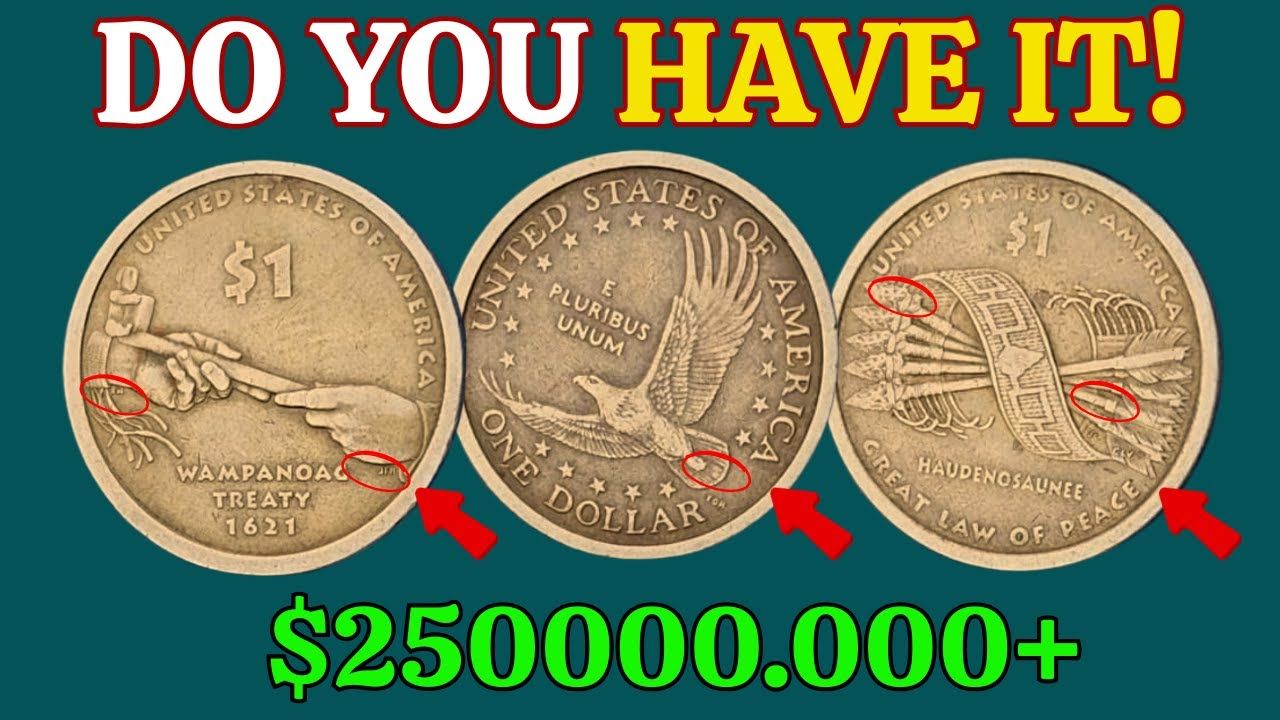
 2021 Native American $1 (Wampanoag Treaty Design) – Worth $5,320
Why it matters
This coin commemorates the 400th anniversary of the 1621 Wampanoag Treaty.
Design features:
- Obverse: Sacagawea with her child
- Reverse: Two hands exchanging a peace pipe

Collectors increasingly value modern coins with strong historical symbolism.
What creates value
Not age—but:
- Sharp hands & pipe detail
- Clean open fields
- Original mint luster
- No contact marks
- Top-tier grading
Only a tiny fraction survive in flawless condition.
Record price
Heritage Auctions (2022):
$5,320
What to check
- Date: 2021
- No major scratches
- Crisp details
- PCGS or NGC MS-68 / MS-69 range
 2010-D Native American $1 – Worth $10,800
Why it’s misunderstood
This issue honors the Haudenosaunee Confederacy and the Great Law of Peace, a foundation of early American democracy.
Denver coins were made for circulation—not collectors.
Most were:
- Bagged
- Transported roughly
- Handled heavily
High-grade survivors are extremely rare.
What collectors look for
- Sharp feathers
- Clear belt design
- Clean mirrored fields
- Strong original luster
- No bag marks
Record price
Heritage Auctions (2017):
$10,800
Identification
- Date: 2010
- Mint mark: D
- Condition must be exceptional
- Certified by PCGS / NGC
 2009 Native American $1 (Three Sisters Design) – Worth $6,900
Why this year is special
2009 introduced the first annual reverse design:
 Corn
Corn
 Beans
Beans
 Squash
Known as the “Three Sisters” agriculture tribute.
At the time, few collectors saved these coins.
Most were:
- Spent
- Tossed in jars
- Scratched in storage
Why condition rarity exploded
Collectors later realized:
- Early series years matter most
- Perfect coins became extremely scarce
- Registry competition increased demand
Record price
Heritage Auctions (2018):
$6,900
What to examine
- Sharp corn leaves
- Clean background fields
- Full cartwheel luster
- No marks or dull patches
- Professional certification
Step-by-Step: How to Check Your $1 Coins
Use this expert checklist:
Step 1 – Check the date & mint mark
Look closely under good lighting.
Step 2 – Inspect the reverse design
Look for unusual or incorrect pairings.
Step 3 – Examine surfaces
Scratches = value loss.
Step 4 – Check detail sharpness
Soft detail = common.
Step 5 – Look for original luster
Not polished shine.
Step 6 – NEVER clean 
Cleaning can destroy 90%+ of value.
Step 7 – Professional grading
Only PCGS or NGC unlock serious auction prices.
 How High-Value Modern Coins Are Sold
Elite coins are sold through:
- Heritage Auctions
- Stack’s Bowers
- Certified marketplaces
- Registry collector networks
Certification + photography + documentation = bidding wars.
 Final Thoughts
Modern coins can become legendary.
Not because of age…
…but because of:
- Mistakes
- Survival
- Condition
- Verification
That “ordinary” golden dollar could be extraordinary.