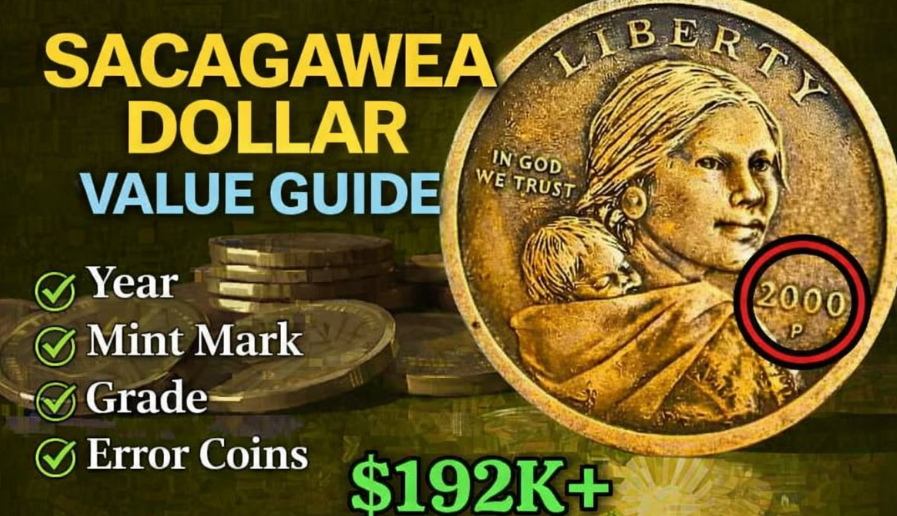
The Sacagawea Dollar has earned a unique place in modern U.S. coinage since its debut in 2000. Created to honor Sacagawea, the Shoshone woman who played a vital role in guiding the Lewis and Clark expedition, the coin symbolizes exploration, resilience, and American history. Although it was originally introduced to replace the one-dollar bill, the coin never became a staple in everyday transactions. Instead, it evolved into a highly collectible piece prized for its golden color, distinctive design, and the existence of rare and valuable error varieties.
This comprehensive value guide explores Sacagawea Dollar prices by year, mint mark, grade, and notable errors, helping collectors understand which coins are common and which can be worth thousands of dollars.
Background and Introduction of the Sacagawea Dollar
The Sacagawea Dollar was officially released by the U.S. Mint in 2000 as part of a broader effort to modernize American currency. Officials hoped a durable, eye-catching coin would encourage the public to move away from paper dollar bills. Sculptor Glenna Goodacre designed the obverse, portraying Sacagawea carrying her infant son, Jean Baptiste, a powerful image symbolizing guidance and motherhood.
The original reverse design, created by Thomas D. Rogers Sr., features a flying eagle encircled by 17 stars, commemorating the states in the Union during the Lewis and Clark expedition. The coin’s distinctive golden hue comes from a manganese-brass alloy, setting it apart from other circulating coins.
Common Sacagawea Dollars and Circulation Value
The majority of Sacagawea Dollars produced since 2000 are considered common coins. Large quantities were struck at the Philadelphia and Denver mints, making them easy to find in rolls, mint sets, and circulation. In worn or lightly circulated condition, most Sacagawea Dollars are worth face value.
However, coins that remain uncirculated or exhibit strong mint luster can be worth slightly more, especially when professionally graded. Proof versions struck at the San Francisco Mint were sold directly to collectors and generally carry higher premiums than circulation strikes.
Rare and High-Value Sacagawea Dollar Varieties
While many Sacagawea Dollars are affordable, certain varieties are among the most valuable modern U.S. coins:
2000-P Cheerios Dollar
This legendary variety was included in promotional Cheerios cereal boxes in early 2000. These coins feature a prototype reverse with sharply detailed eagle tail feathers. Authentic examples are extremely rare and can sell for thousands of dollars.
2000-P Goodacre Presentation Dollars
As compensation for her design work, Glenna Goodacre received 5,000 specially struck coins. These pieces were preserved in exceptional condition and are highly sought after by collectors.
2000-P Mule Error
One of the most famous modern coin errors, this variety combines a Sacagawea Dollar obverse with a Washington Quarter reverse. Fewer than two dozen are believed to exist, and auction prices can exceed six figures.
2007 Enhanced Collector Issues
Certain 2007 Philadelphia and Denver issues were produced with enhanced finishes for collectors, making them scarcer than standard strikes.
Native American Dollar Series (2009–Present)
Beginning in 2009, the U.S. Mint replaced the eagle reverse with annually changing designs honoring Native American achievements. Some low-mintage years are more valuable than others.
Sacagawea Dollar Year and Mint Mark Value Chart
| Year | Mint Mark | Notable Feature | Estimated Value Range |
|---|---|---|---|
| 2000 | P | Cheerios reverse variety | $5,000 – $25,000 |
| 2000 | P | Goodacre presentation strike | $500 – $1,500 |
| 2000 | P | Mule error (quarter reverse) | $50,000 – $200,000 |
| 2001 | D | Lower mintage issue | $2 – $20 |
| 2007 | P/D | Enhanced collector finish | $10 – $50 |
| 2009 | P/D/S | First Native American reverse | $2 – $25 |
| 2010–2026 | P/D/S | Annual Native American designs | $2 – $30 |
Values depend heavily on condition, certification, and market demand.
Sacagawea Dollar Error Coins to Watch For
Error coins add excitement and value to Sacagawea Dollar collecting. Some of the most desirable errors include:
- Mule Errors: Coins struck with mismatched obverse and reverse dies
- Double Strikes: Overlapping images caused by multiple strikes
- Off-Center Strikes: Partial designs due to misalignment
- Planchet Errors: Coins struck on blanks intended for other denominations
High-grade error coins can command impressive premiums at auction.
Why Coin Grading Matters
Professional coin grading is essential when determining Sacagawea Dollar value. Third-party grading services evaluate a coin’s condition, authenticity, and surface quality. Coins graded Mint State 67 or higher can be worth significantly more than ungraded examples. Certification also provides buyer confidence, making graded coins easier to sell and insure.
Sacagawea Dollar Market Trends in 2026
As of 2026, interest in Sacagawea and Native American Dollars remains strong. While common coins trade modestly, rare varieties and errors continue to break auction records. The Cheerios Dollar and 2000-P Mule Error remain top-tier modern rarities, while Goodacre Presentation Dollars maintain steady demand. Annual reverse changes keep the series fresh and appealing to collectors.
Collector Perspectives and Long-Term Appeal
Many collectors appreciate the Sacagawea Dollar for its historical significance as much as its numismatic value. Some pursue complete date-and-mint sets, while others specialize in proofs or error coins. The series appeals to beginners due to its affordability and to advanced collectors because of its rare, high-value varieties.
Conclusion
The Sacagawea Dollar is a fascinating blend of American history, modern minting technology, and collectible intrigue. While most examples are easy to obtain, select varieties and errors elevate the series into elite collecting territory. From the iconic 2000-P Cheerios Dollar to the elusive Mule Error, these coins continue to captivate collectors in 2026. With the right knowledge and careful inspection, even an ordinary-looking coin could turn out to be a hidden treasure.