What if the most valuable item you own is already sitting in your wallet?
Believe it or not, certain $1 bills can be worth as much as $150,000 to collectors. These rare bills are often overlooked and accidentally spent every day.
In this article, you’ll learn exactly what to look for, how to spot valuable serial numbers, and how to avoid losing a small fortune by mistake.
Attention: Do not skip this guide. This is not clickbait. There is no catch. There is a real, tangible possibility that you have a $1 bill hiding in your wallet, album, or change jar that could be worth upwards of $150,000. I’m going to show you exactly what to look for, how this happened, and how you can join the hunt for one of the most fascinating numismatic errors in modern history.
Quick Summary: Due to a 2016 clerical error by the U.S. Bureau of Engraving and Printing,
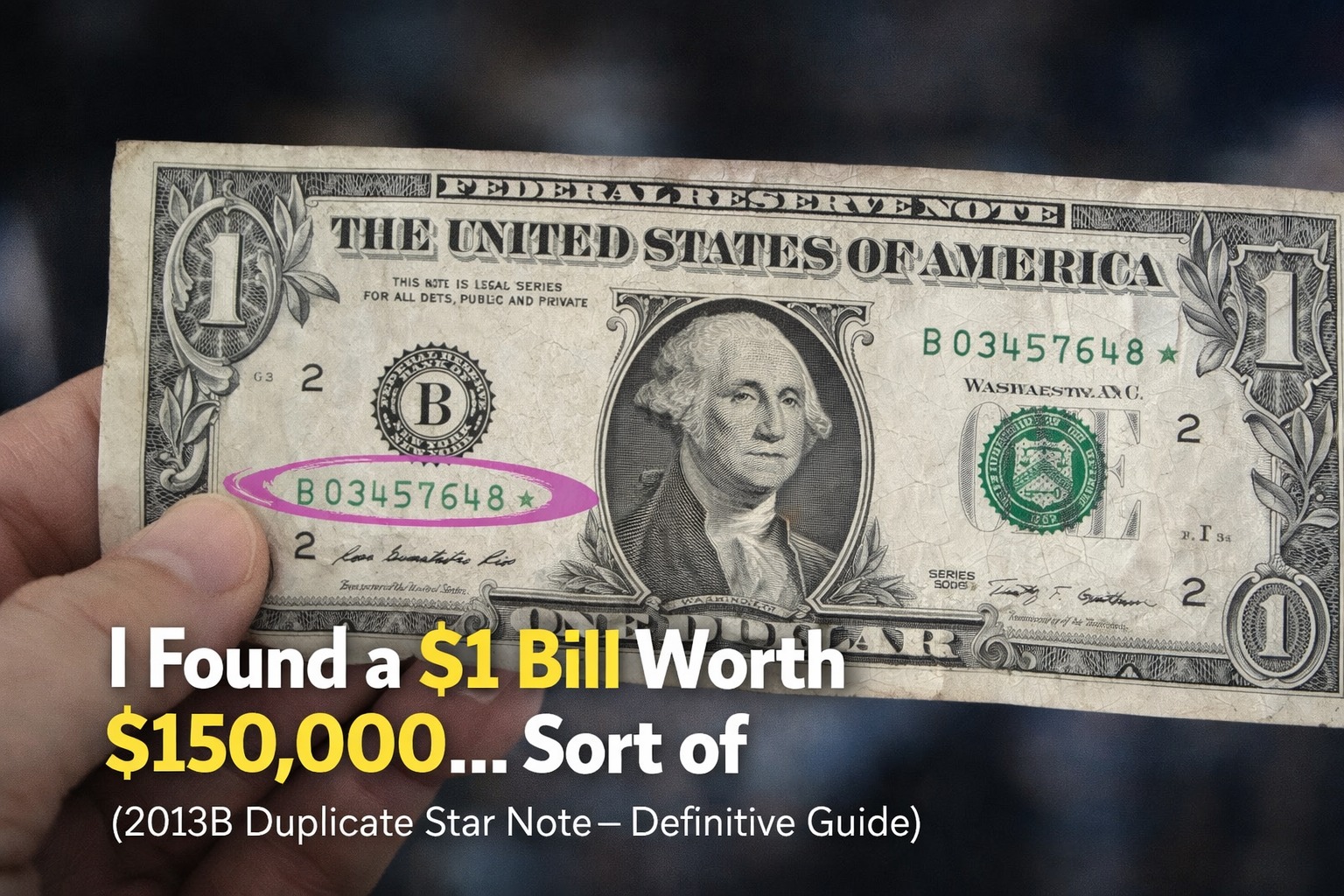
6.4 million Series 2013 $1 Star Notes from the New York Federal Reserve (Serial Range: B00000001-B00250000 & B03200001-B09600000) were printed twice. Alone, each bill is worth $1. But if you find its *identical serial number match”, the pair becomes a numismatic treasure worth $20,000-$150,000+.
How Did This Happen? The $150k Duplicate Printing Error
In November 2014, the Bureau of Engraving and Printing (BEP) in Washington, D.C., printed 6.4 million Series 2013 $1 Star Notes for the New York Fed. Star notes are replacement notes printed when a regular bill is damaged during production. Each is supposed to be unique.
Then, in July 2016, due to an internal clerical error, the BEP sent the exact same print order to its Fort Worth, Texas facility. The error went unnoticed, and a second, identical run of 6.4 million star notes with the same serial numbers was printed and released into circulation.
Essentially, the U.S. government accidentally “counterfeited” its own money. The BEP didn’t publicly announce this. The discovery was made by sharp-eyed collectors using the Freedom of Information Act. This created 6.4 million potential pairs of matching notes now scattered across the country.
How to Identify the Valuable 2013B Duplicate Star Notes
Finding one is straightforward. You only need to check three things on any Series 2013 $1 bill:
1. Series Date: Must be “Series 2013”.
2. Federal Reserve Seal: Must have a “B” (denoting the New York Federal Reserve Bank).
3. Serial Number: Must fall into one of these two specific ranges:
Low Range: B00000001 to B00250000
High Range: B03200001 to B09600000
And it MUST be a Star Note (the serial number ends with a star * symbol).
Visual Check: The bill will look completely normal except for the series (2013), the “B” seal to the left of George Washington, and a serial number in the ranges above with a little star at the end.
Visual Check: The bill will look completely normal except for the series (2013), the “B” seal to the left of George Washington, and a serial number in the ranges above with a little star at the end.
The Zegers/Winograd Project: Finding the Match to Your $150k Bill
Finding one note is thrilling, but its true value is unlocked only when you find its perfect twin-the note with the exact same serial number from the duplicate print run.
This is where the incredible
Zegers/Winograd (ZW) Project comes in. Run by dedicated volunteers, it’s a master database tracking every identified note from this error. If you find a note:
You submit its details to the ZW database.
If its match is already listed, they connect the two owners to facilitate a sale/trade.
If not, your note is added, and you wait for someone to find the match.
To date, only ~11,000 notes of the 12.8 million have been logged, and only 9 complete pairs have been matched. None have been sold publicly, but experts value graded pairs from $20,000 for common serials to $150,000+ for low serials (like B00000001).
Act Now – Time is Running Out: The average lifespan of a $1 bill is only 5.8 years. These 2013 notes are being worn out and destroyed every day. The window to find them in circulation is closing.
Step-by-Step: What to Do If You Find a Note
1. Examine Carefully: Confirm it’s a Series 2013, “B” seal, star note in the correct serial range.
2. Protect It: Place it in a currency sleeve or holder to prevent damage.
3. Check the Database: Go to the official ZW Project site or use the form on TheSilver Picker.com/zw-project (link in description of the original video) to see if your serial number is already listed.
4. Submit Your Note: If it’s new, submit it to the database to claim your spot.
5. Spread the Word: Share this information. The more people looking, the higher the chance matches are found.
Conclusion: Your Chance to Be Part of Numismatic History
This isn’t just about potentially making life-changing money. It’s about participating in one of the largest and most exciting treasure hunts in modern coin and currency collecting. You don’t need to be an expert. You just need a keen eye and the knowledge from this guide.
Back to the top
Start today. Check your wallet, your tip jar, your old collections. Teach your family and friends what to look for. By sharing this guide and increasing awareness, you directly increase the odds that these rare pairs will be united, preserving a incredible story of a government error that created a collector’s dream.
Watch Video
Article Source & Credit: This guide is based on the comprehensive research from the Zegers/Winograd Project and numismatic experts. The original video explanation by Silver Picker sparked widespread interest. Always verify notes through official numismatic channels.
Watch Video
Article Source & Credit: This guide is based on the comprehensive research from the Zegers/Winograd Project and numismatic experts. The original video explanation by Silver Picker sparked widespread interest. Always verify notes through official numismatic channels.