Don’t think that every quarter is worth only 25 cents. Many of the rarest and most expensive U.S. quarters are still out there, hidden in old coin rolls or put away in change jars. It’s possible to find these gems that are worth hundreds or even thousands of dollars.
A lot of them are valuable because of mistakes made by the mint, years when not many were made, or unique features that make them stand out from other coins. Whether you’re an experienced coin collector or just like looking at your change, these six rare quarters could be in your pocket right now. Here’s why they’re so valuable.
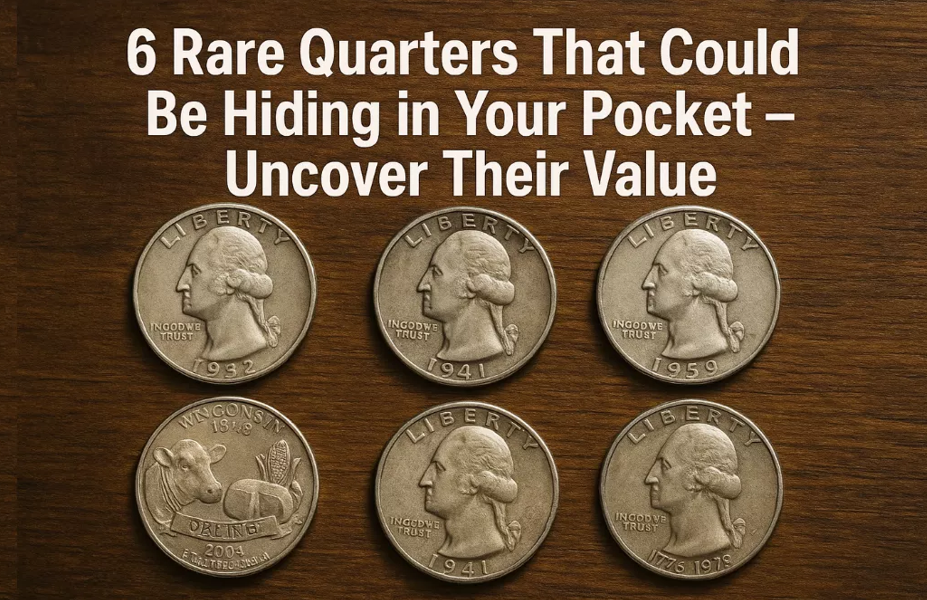
1. 1932-D Washington Quarter
One of the most important numbers in the Washington quarter series is the 1932-D, which is also by far the most valuable. It was made in Denver the first year the Washington quarter came out, and less than 500,000 were made. That makes it one of the quarters with the least amount of coins made in the 20th century. Even though it’s been used a lot, this coin is still rare and can fetch $100 to $300.
If you can find one in a better grade with clear features and little wear, you might find a coin worth more than $1,000. Not only is it very rare, but it is also historically important because it marked the 200th anniversary of George Washington’s birth. Pay close attention to your coin jars and rolls. A lot of people think it’s just a regular Washington quarter and don’t know what it’s really worth.
2. 1950-D Washington Quarter
The 1950-D quarter is prized by fans because good grades are hard to find. It is not as rare as the 1932-D quarter. Many coins were used a lot after World War II, and there aren’t many mint-condition copies left today. In 1950, the Denver Mint made about 21 million quarters. It is very rare to find one that is still mint.
Depending on the grade, a well-kept one with a strong shine and no signs of wear could be worth $50 to $300 or more. Watch out for examples with all the details, especially ones that are rated MS65 or higher. Because these coins were used and abused so often, it’s extra cool to find one that’s in great shape.
3. 1965 Silver Error Quarter
The U.S. Mint changed quarters from being 90% silver to being copper-nickel covered in 1965. But some 1965 quarters were made on extra 90% silver planchets by mistake. There are very few of these error coins, and based on their state, they can fetch $5,000 to $10,000 or even more. You can use a magnet to check it (silver is not magnetic) or weigh it. Clad quarters weigh 5.67g, while silver quarters weigh 6.25g.
As the Mint slowly stopped making silver coins, these 1965 quarters that were struck in silver were probably made by mistake. This is something that most people don’t even think to check: 1965 quarters are thought to be fully dressed. But a quick glance could reveal something amazing.
4. 1970-S Proof Washington Quarter (Struck on 1941 Canadian Quarter)
It’s one of the rarest mint mistakes ever seen. A well-known “double-denomination” mistake is the 1970-S proof quarter that was made from a 1941 Canadian quarter. Since only a few have been found, they are pretty much worthless. A lot of money was paid at sale for one.
It’s easy to spot because the Canadian design is still visible under the U.S. quarter’s highlights. Even though it was a proof coin, you probably wouldn’t find it in loose change. However, mistakes like this do happen and end up in the hands of people. If you think you have a quarter that looks odd, like one with strange doubles or a foreign stamp, you should get it checked out.
5. 2004 Wisconsin Quarter With Extra Leaf
There is a well-known and valuable mistake on some 2004 Wisconsin state quarters: the corn husk image on the back of some coins has an extra leaf. It comes in two different styles: the “Extra Leaf Low” and the “Extra Leaf High.” These strange variations probably happened because dies got gouged by accident while the coins were being made.
Depending on their state, these mistake coins have sold for $100 to $500. The rarer ones have gone even higher. People who like to collect modern errors love this quarter, and you can still find it in circulation. You should take another look at this if you live in or near Wisconsin or got one of these in cash.
6. 1983 Washington Quarter With No Mint Mark and Doubling
Another hidden gem that you might find right now is the quarter from 1983. Most quarters from 1983 were made at the Philadelphia Mint, so they don’t usually have a mint mark. More interesting, though, are the 1983 quarters that have strong doubles on them, especially on the words “LIBERTY” and “IN GOD WE TRUST.”
These are errors called doubled die obverse (DDO). Doubling isn’t very expensive, but good DDO coins can fetch $200 to $1,000 or more, based on how clear and graded they are. Always look closely at 1983 quarters to see if the letters have extra thickness or ghosted edges. This is a small thing that could be worth a lot of money.
Conclusion
A quarter might seem like small change, but some of them are worth a lot more than 25 cents. When you look hard enough, you can still find treasure. These six rare quarters are proof of that.
Carefully looking over your coins could lead to an exciting find, whether it’s a silver mistake, a mint mistake, or a rare coin that was only made in small numbers. Next time you break a $20 bill and get quarters as change, look at them for a moment. You might find a small fortune hidden there.
FAQs
Are special quarters still being used?
Yes! Even though rare quarters aren’t common, they do get used sometimes, especially when people spend old coins from coin jars or collections they didn’t know they had.
How can I tell if my quarter is valuable?
First, look at the date and the mint mark. Then look for things that don’t seem right, like doubles, off-center hits, or mistakes in the design. Silver planchets can also be found by weighing them and checking them with magnets.
Should I clean a rare quarter to make it look better?
Do not clean a coin. Cleaning a coin makes it worth a lot less, especially if it is rare or valuable. Coin sellers and collectors like coins that are in their natural, unaltered state.